
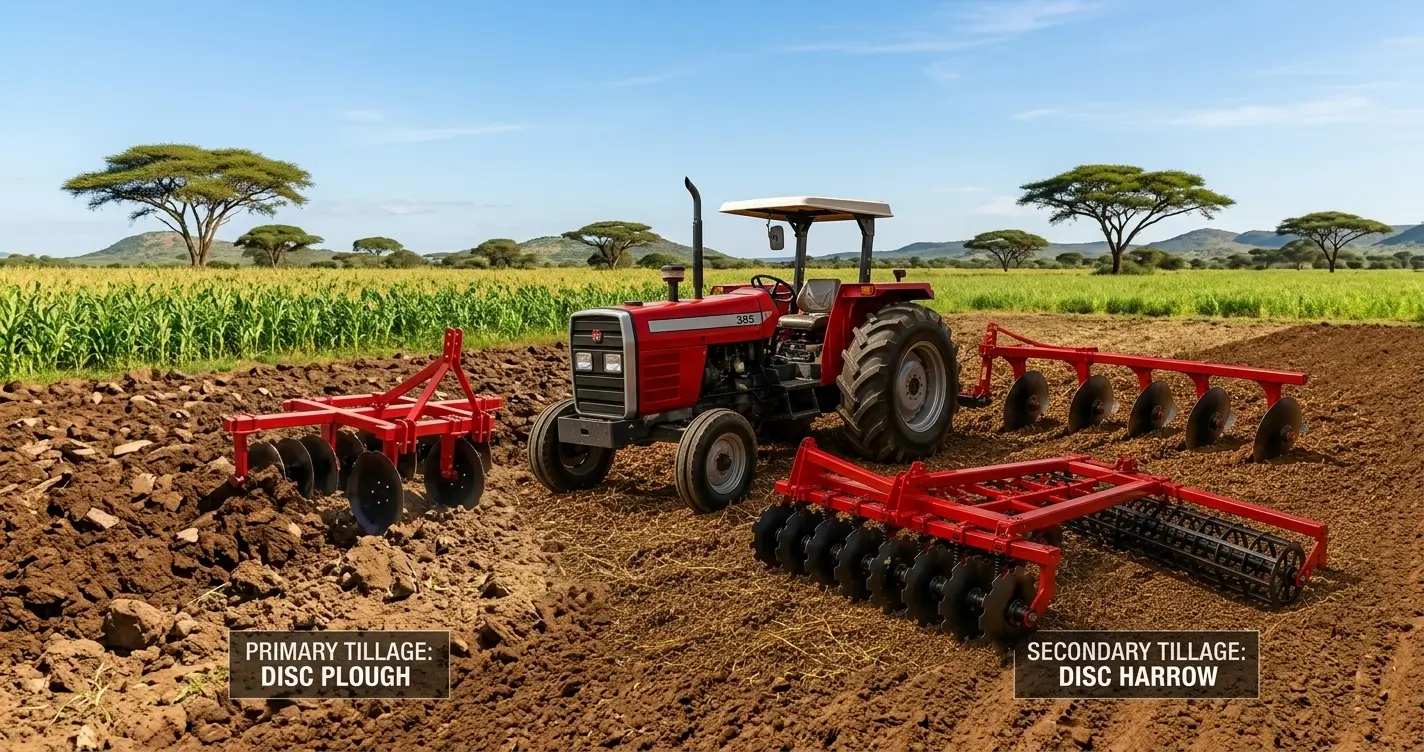
Choosing between a disc harrow and a plough depends on your soil type and the stage of land preparation. A plough is a primary tillage tool that cuts deep and inverts the soil, while a disc harrow is a secondary tool that works shallower to break clods and refine the seedbed. Most Zimbabwean farmers use both, in sequence, rather than choosing just one.
What Does a Disc Plough Do?
A plough, whether moldboard or disc type, breaks hard ground and turns the soil over. This buries weeds and old crop residue, exposing fresh soil underneath. Disc ploughs are particularly suited to hard, dry, stony or sticky conditions, which makes them a common choice across Zimbabwe’s clay-rich soils. Ploughing is typically the first step in preparing a field before planting maize, soya beans, wheat or tobacco.
What Does a Disc Harrow Do?
A disc harrow works the soil at a shallower depth than a plough, generally reaching only the top layer rather than deep below the surface. Its job is to break up clods left behind after ploughing, chop remaining residue and level the field so seeds can be planted evenly. Because it works lighter and faster, a disc harrow is often used as a follow up step rather than a standalone tillage method.
Disc Harrow vs Disc Plough: What’s the Real Difference?
The clearest difference between the two is working depth and purpose. A plough is built for deep, primary tillage that inverts and loosens compacted soil, while a disc harrow handles shallow, secondary tillage that smooths and refines the seedbed. Ploughing demands more tractor power and fuel per hectare, whereas harrowing is generally quicker and less demanding on equipment.
Which Should You Choose for Your Zimbabwean Farm?
A plough is better suited for farmers breaking new ground, dealing with compacted or stony soils, or needing to bury heavy crop residue before the rainy season begins. A disc harrow works best when the soil has already been ploughed and simply needs clod breaking, leveling and seedbed finishing before planting. Many commercial and smallholder farmers in Zimbabwe use both tools together, ploughing first and harrowing second, for the best seedbed results. Farmers practising minimal tillage approaches, such as Pfumvudza or Intwasa, may rely less on deep ploughing and more on targeted, reduced disturbance methods.
If you’re preparing for the 2026 planting season, exploring the right implements for your soil type is a useful first step, and tractors.co.zw is a place where Zimbabwean farmers can browse tractor and implement options to match their land preparation needs.
Frequently Asked Questions
Can I use a disc harrow instead of a plough?
On already loose or sandy soils, some farmers skip ploughing and go straight to harrowing. However, on hard or compacted ground, ploughing first usually gives better results.
Which tool is better for clay soils in Zimbabwe?
A disc plough generally handles heavy clay soils more effectively, since it is designed to cut through hard, sticky ground that a harrow alone cannot break.
Do I need both a disc plough and a disc harrow?
Most farmers benefit from using both, ploughing to break and invert the soil, then harrowing to refine the seedbed before planting.
Tags: agriculture, farming, machinery, tractors, zimbabwe